Showing posts with label Stapleton Nebraska. Show all posts

Monday, July 24, 2017

Highway 83 Town of Stapleton, Nebraska to Have its Day in the Sun


By Stew Magnuson
Photo: By Stew Magnuson
To say that Monday, Aug. 21, 2017 will be the biggest day in the history of the Highway 83 town of Stapleton, Nebraska, may be an understatement.
That will be the day when it will be one of the Top 10 best spots in the nation to see the Great American Solar Eclipse.
Estimates of the numbers of folks who will flock to this town of 299 souls range anywhere from 5,000 to 15,000, but the truth is, no one really knows how many to expect.
Stapleton is what I consider my second hometown. My father and uncle were raised there and I spent many summers and holidays visiting my grandparents, who were lifelong residents. The VFW Post is named after my cousin, Staff Sgt. Edwin L. Magnuson, who died fighting in Italy in World War II.
Its previous claim to fame was being profiled as a typical small town” in the Jan. 2, 1971 New Yorker, in an article title “A Peaceable Town.” I devoted a chapter to Stapleton in my book, The Last American Highway: A Journey Through Time Down U.S. Route 83; Nebraska-Kansas-Oklahoma.
Now the spotlight will be on this quiet village again.
Town leaders have known about the eclipse for years, and at first were promoting it with banners on light poles and thinking up fund-raising opportunities. A local expert and eclipse fanatic was brought in to brief them on the type of crowds to expect. They moved the annual county fair and rodeo to the Saturday and Sunday prior to the eclipse as visitors from around the world were expected to come in advance (See schedule below). There will be TV crews from as far away as Poland there to report the event live.
The fairgrounds and local golf course will be charging a small fee to those who want a good spot to watch. Excitement for the prospects of Stapleton’s “day in the sun” is turning into apprehension. The eclipse has so far garnered little attention in national media, but the hype machine will soon be ramping up as the day grows closer.
Stapleton has one gas station/convenience store and one small co-op grocery store and one restaurant — no motels.
As my cousin recently told me, every inch of the town is spoken for when it comes to accommodations. I for one will be pitching a tent in a cousin’s yard the evening before. On any other night, I could show up unannounced and have a place to stay. Not on Aug. 20 though!
Those who plan on traveling to Stapleton should come with a full tank of gas, food, water and sunscreen to last the day. Make sure you have IPO certified glasses to view the eclipse.
Travelers should plan on getting there in plenty of time. One can envision traffic jams on Highway 83. Those who don’t make it in time will probably just pull over to watch, which might exacerbate the problem. 
I know the people of Stapleton have been working hard to for several years to accommodate the huge influx of visitors expected. But they can only do so much.
Visitors should come prepared. It would be great if they can spend a little money to help the town defray its costs — buy a t-shirt, a grilled hamburger, watch the eclipse from inside the fairgrounds, etc., but keep in mind that there are no Wal-Marts, Walgreens or 7-11s around. Those are 30 miles to the south in North Platte.
Respect private property and don’t trespass. Dispose of cigarette butts properly. It’s a dry country.
All that being said, it should be worth the trip and the advanced planning.
For many, this will serve as an introduction to traveling on beautiful Highway 83 in Nebraska and the alluring and stunning Sand Hills.
A total solar eclipse is said to be a near spiritual event and for most — a once-in-a-lifetime opportunity. Experiencing it in the wide-open Sand Hills will be amazing.

Friday August 18

Noon - Craft Fair and Flea Market
7:30pm - Logan County Rodeo: $15/Adults, $5/Ages 6 - 11
Saturday August 19
7:30am - 5K Eclipse Run/Walk: $25/person
8:00am - 11:00am - Pork Breakfast at the Fairgrounds
10am - 6pm - Craft Fair and Flea Market
Entertainment throughout the day: For young and old alike, games and activities for kids
2pm - Parade in downtown Stapleton
Food Vendors - On site throughout the day
6pm - Mutton Bustin' and Chicken Scramble for kids ages 3-15 at the Fairgrounds
7:30pm - Logan County Rodeo: $15/Adults, $5/Ages 6-11
8:00pm - 1:00am - Street dance and beer garden in downtown Stapleton, $10/person
Sunday August 20
9am - non-denomination church service at the fairgrounds
10am - 5pm - Craft fair and flea market
Noon - Working Ranch Rodeo at the Fairgrounds: $3/person
Food Vendors - On site throughout the day
Sundown (approximately 8:30) - Eclipse Presentation by Derryl Barr
Monday August 21
Eclipse viewing at the Logan County Fairgrounds! $10/person, ages 5 and under free. Includes viewing glasses, water bottle and entry into the "After the Eclipse" Bash.
Craft fair and flea market, food vendors on site throughout the day.


Join the Fans of U.S. Route 83 Facebook page HERE.

Stew Magnuson is the author of the Highway 83 Chronicles, a series of three books about history and life found along U.S. Route 83. The final book, The Last American Highway: A Journey Through Time Down U.S. Route 83 in Texas was released in March 2017 and follows The Last American Highway: The Dakotas, and The Last American Highway: Nebraska-Kansas-Oklahoma, edition.
All three are available ONLINE or in bookstores and gift shops along Highway 83.
For signed copies or retail opportunities contact him HERE

Wednesday, May 20, 2015

A Memorial Day Tribute to Staff Sgt. Edwin L. Magnuson of Stapleton, Nebraska


Edwin L. Magnuson
There are undoubtedly hundreds of war heroes who hail from towns found along Highway 83.
Marine Corps Corp. Harlan Block, one of the six portrayed on the Iwo Jima War Memorial, was from Harlingen, Texas. Medal of Honor recipient Army Master Sgt. Jose Medoza Lopez was from Mission, and a statue commemorating the day he single-handedly repulsed a German infantry attack stands in Brownsville.
I would like to take this Memorial Day week to record the story of my second cousin Army Staff Sgt. Edwin Lloyd Magnuson from Stapleton, Nebraska, who earned the silver star for his bravery in World War II.
Lloyd, as he preferred to be called, grew up in the Sand Hills town, a terminus for a Union Pacific spur line, long before the highway reached it.
He was the son of my grandfather’s older brother, Guy.
He enlisted in the Army at age 19 on Sept. 25, 1941, and after bootcamp was sent to Fort Lewis, Washington, a topography and climate about as different as it could be from the arid Sand Hills. He waited almost a year to be deployed.
He wrote a letter home to his mother Mable Magnuson during his waning days there, expressing his frustration. His unit was wiling away the days guarding airplanes at a nearby Army air base to keep busy.
“I would rather be on the front lines fighting,” he wrote. Meanwhile, he was at risk of not going at all. He had an inflamed tendon cord and if it got any worse, the doctors would operate on it, and discharge him. But that didn’t come to pass. He wrote that they had recently received orders to clean out their footlockers of all unnecessary items, and to toss everything except what they had been issued. The time was near.
At some point during that year, he had returned to Stapleton on leave. That was the first memory my cousin Elaine Barner — about four years old at the time — has of her brother. She saw him standing on the bathroom shaving. “I expect that you’re my brother Lloyd,” she said.
“I expect that I am,” he told his baby sister.
Magnuson (far left) digs into some steaks at Ft. Lewis, Wash.
Elaine has some pictures of what we presume is his time in Washington. One is of his unit in what looks like a mess hall. The soldiers have big, thick cut steaks. It’s doubtful they featured that at every meal. However, despite the jokes made about Army chow, many from humble beginnings such as  Lloyd probably never ate so well.
Eventually, Private Magnuson received his wish. The letter is undated, but if he was indeed deployed shortly after writing it, it was mailed October 1942. A month later he would find himself in the North Africa campaign fighting German troops as the 3rd Infantry Division swept across Morocco. We know little about his time there. One record I have found says he specialized in radio communications. And by the time he was 20 years old, we know he had been promoted to sergeant — remarkable for someone that age.
Eventually, the 3rd Infantry under the newly formed Fifth Army found itself in the Italian campaign. First came the invasion of Sicily in July 1943. A little more than a month later, allies landed at the toe of Italy. In September 1943, somewhere on the Italian mainland, he earned the silver star for gallantry in action.
His citation reads:  “On the 13th of October, 1943, while his company was engaging
Gen. Mark Clark pins the silver star on Magnuson.
the enemy, Sergeant Magnuson observed that the left flank of his company was endangered by several of the enemy firing machine pistols from a ditch by the road.
“He worked his way toward them, taking advantage of all cover, until he had approached to within 20 yards of the enemy, he then opened fire with his sub-machine gun, killing three of the enemy and capturing the other four.”
Elaine has a picture of Lt. Gen. Mark Clark pinning the silver star on Lloyd. He had also by this time earned a Purple Heart for wounds sustained in action, although we have no details how or where we was hurt.
Next for the Fifth Army was the beach landing at Anzio, known as Operation Shingle. Its ultimate goal was to capture Rome, some 40 miles to the northeast. The landing took the Axis troops by surprise, but Commanding General John P. Lucas failed to take advantage of the situation, preferring to establish a strong beachhead as a base instead. The decision to stay put allowed German troops to rally, and the Battle of Anzio would continue for another month.
It was two days after the first landing, January 24, 1944, when Lloyd was killed in action.
We currently don’t have any details about the circumstances of his death. Elaine remembers reading a letter written by a fellow soldier to her mother that said he died instantly and didn’t suffer, but she doesn’t have a copy of the letter now.
Staff Sgt. Edwin Lloyd Magnuson became the first from Logan County to be killed in action in World War II. The Veterans of Foreign Wars Post #8258 in Stapleton is named in his honor. He is buried at the Fort McPherson National Cemetery east of North Platte.
Lloyd was just one of 42,310 Americans who lost their lives or went missing in action during the Fifth Army’s 20-month-long Italian campaign.

My thanks to Elaine Barner for sharing these photos and newspaper accounts of her brother.

Stew Magnuson is the author of The Last American Highway: A Journey Through Time Down U.S. Route 83: The Dakotas, available at Amazon.com and bookstores and gift shops along Highway 83. And The Last American Highway: Nebraska Kansas Oklahoma edition.

To join the Fans of U.S. Route 83 group on Facebook, CLICK HERE. And check out the U.S. Route 83 Travel page at www.usroute83.com.  Contact Stew Magnuson at stewmag (a) yahoo.com


Thursday, May 8, 2014

Stop Nebraska Public Power From Destroying the Beauty of the Sand Hills on Hwy 83


By STEW MAGNUSON
Easter Sunday morning last month, I woke up in Stapleton, Nebraska, at 5:30 a.m. so I could get on the road going north early.
I knew I had one of the most beautiful drives in the state ahead of me. Indeed, the morning light bathed the one of Nebraska’s great secrets and treasures, the Sand Hills, in soft morning light as I drove up U.S. Highway 83.
Imagine something like this..
I had to stop about once every mile to take a picture of this unique landscape.
Just the night before one of my cousins had told me of the Nebraska Public Power District’s plan to plant giant power lines along this scenic highway. “Surely, that can’t be true,” I thought.
.... planted across the beautiful Dismal River...
... or strung along a landscape like this. Photos by Stew Magnuson
Unfortunately, it is. NPPD’s R-Project would install giant power line towers along the road. This is actually its “preferred” route. There are alternatives away from the highway.
Nebraskans, lovers of the prairie, fans of our nation’s scenic highways must unite to defeat this ill-conceived plan.
Many, sadly, don’t know what is at stake.
The proposed power line route hugs the highway so closely it is actually impossible to distinguish the two on the map NPPD provides. (Link to map here). The monsterous lines will be clearly visible from the road.
Along with scarring the natural beauty of the Sand Hills, the towers would mar one of the most beautiful river valleys in the state, the Dismal River.
I remember meeting a motorcyclist at the scenic overlook at the Dismal River in 2009.
“It’s not so dismal,” he told me.
The Dismal was named because early settlers found it so treacherous to cross. It has nothing to do with its natural beauty. In that regards, it is a total misnomer. If this plan goes forward, motorists will gaze down from the overlook and see steel towers carrying power lines.
The biker explained that he had ridden up Interstate 80 on his way to Colorado a half dozen times, but had never ventured north. He was amazed at what he had been missing.
So too will other travelers. There was once a U.S. Canada Highway 83 Association that encouraged motorists to take this Great Plains highway, and spend some of their dollars in the small towns along the way. The association is long gone, but the idea lives on. Other states such as Kansas are declaring some of their roads Scenic Byways, and heavily promoting them as a way to encourage motorists passing through to get off the Interstate and come see what its communities have to offer.
This is what Nebraska should be doing — not destroying the natural beauty of our prairie lands.
Highway 83 from the Kansas border south of McCook to the South Dakota north of Valentine should be declared a Scenic Byway and developed for tourism.
In the 1970s and 1980s, Nebraskans from both parties joined together to stop the Bureau of Land Reclamation from damming the Niobrara River. (Does anyone today regret fighting that fight?) A similar alliance helped steer the proposed Keystone XL oil pipeline route out of the Sand Hills.
We can all come together again to defeat another bad idea.
Nebraskans, and anyone who travels this federal highway, must speak out to defeat a poorly thought out plan to string ugly power lines along one of the state’s most stunning landscapes.
Leave comments on the NPPD’s website (LINK HERE), speak out at the public hearings, write letters to lawmakers and authorities.
Stop the R-Project’s Preferred route through our beautiful Sand Hills.

Stew Magnuson is the author of The Last American Highway: A Journey Through Time Down U.S. Route 83: The Dakotas, and winner of the 2009 Nebraska nonfiction book of the year: The Death of Raymond Yellow Thunder.

To join the Fans of U.S. Route 83 group on Facebook, CLICK HERE. And check out the U.S. Route 83 Travel page at www.usroute83.com.  Contact Stew Magnuson at stewmag (a) yahoo.com

Wednesday, January 22, 2014

Guidebook Takes Readers on Tour of Buffalo Bill Cody's Life Along Highway 83, and Beyond


By STEW MAGNUSON 
A native of Omaha, Nebraska, Jeff Barnes over the past few years has made a name for himself publishing a series of guidebooks on the Old West as well as traveling the Great Plains lecturing on the topic. Forts of the Northern Plains in 2008 came first, and told readers how to locate 51 forts in Iowa, Minnesota, North Dakota, South Dakota, Nebraska, Wyoming and Montana. Next came The Great Plains Guide to Custer: 85 Forts, Fights and Other Sites in 2011. On February 1, his publisher Stackpole Books will release The Great Plains Guide to Buffalo Bill. William F. “Buffalo Bill Cody” is associated with several sites along Highway 83, not the least of which is his home of about 16 years, Scout’s Rest Ranch in North Platte, Nebraska. Barnes in an email interview explains how the book came about/

SM: Tell us how you began specializing in writing guidebooks centered on Western history?
JB: I’ve always loved visiting the old forts and battlefields of the Indian wars, and had a little checklist to click them off as I did. Every time I stopped to see the Fort Sidney (Nebraska) site, however, it was closed. I first had an idea to create a list for my glove compartment of the sites I hadn’t seen yet, including their hours, directions and contact info, so I wouldn’t make a wasted trip. From that, I thought about making an expanded list for friends who shared my interest, and then it was just a short leap to think it might be a book.

SM: After writing guidebooks about forts of the Northern Plains and Lt. Col. Custer, you chose Buffalo Bill Cody? Why him? Why has he endured as such as popular figure in U.S. history?
JB: Actually, and this will sound goofy, but I was kind of looking for a sign on who to write about next. Buffalo Bill was one of about five topics I was considering, and I thought a 2012 road trip/speaking tour through Kansas might give time to sort it out. One of the stops was in Leavenworth, Kansas, and there on the wall of my motel room was a portrait of — you guessed it — Buffalo Bill. I called my editor the next day.
Bill Cody was a natural extension of the first two books – he was known at the forts and was a Custer contemporary.
I think he’s endured as a popular figure because he did so much to build his brand when he was alive. He was the one who had hundreds of dime novels and books published about himself, who advertised himself and his show and traveled and performed so extensively. He was a romantic figure who presented a very romanticized American West and successfully included himself as a major player in its history.  He used public relations incredibly well, and he was also a very attractive man whose broad Stetson, long hair and distinctive goatee were eye-catching. And he had a name you couldn’t forget either! It’s easily argued that he was the nation’s first superstar.

SM: Scout’s Rest Ranch in North Platte, Nebraska, is of course the most famous site on Highway 83 associated with Cody. What are some others that aren’t as well known? For example, I heard he once ran cattle north of the Dismal River?
Scout's Rest Ranch, North Platte, Nebr. Photos by Stew Magnuson
JB: His ranch on the Dismal with Frank North was farther to the west from Highway 83, about 65 miles to the northwest of North Platte near Tryon.
Easily visible from 83 to the north of Stapleton on the South Loup River, is the unmarked site of the 1872 skirmish with Sioux Indians [Lakotas] that resulted with Cody being awarded the Medal of Honor.
As you pass through Wellfleet, Nebraska, and cross Medicine Creek, you are very near the unknown site of where Cody, Custer, Gen. Phil Sheridan and Grand Duke Alexis of Russia took lunch and changed horses on their way to their campsite of the Grand Buffalo Hunt. That hunt is commemorated by a state historical marker near Red Willow Creek, between Highway 83 and Hayes Center.
 Across the border into Kansas, near the town of Traer [a few miles southwest of Cedar Bluffs] is a landscape formation called Elephant Rock. Cody was also involved with an Indian skirmish there while with the Fifth Cavalry in 1869.

SM: Oakley, Kansas, has a dramatic statue dedicated to Cody. What do we know about his time in that area?
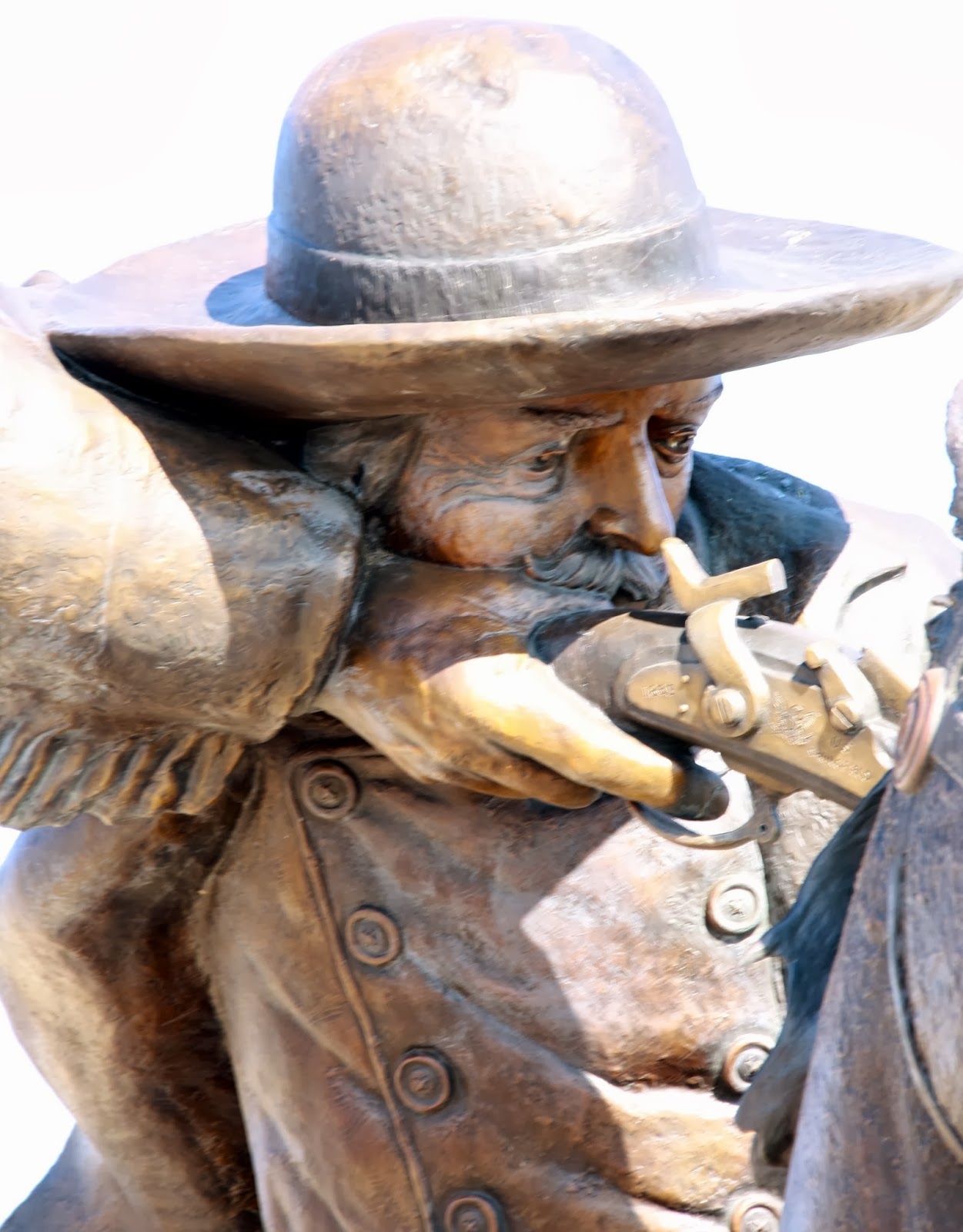
JB: That statue is a commemoration of where Bill Cody “won” the name Buffalo Bill. A few miles west of Oakley on U.S. 40 is a depression in the ground where a supposed buffalo-shooting contest between Cody and Bill Comstock was held in 1868. Both had been nicknamed Buffalo Bill and this contest was to determine who owned the right to the name. Cody, of course, won. The story came out years after the event and after
Buffalo Bill memorial, Oakley, Kansas
Comstock was dead, leading to suspicions the story was created just to support the Buffalo Bill “legend” that was starting to grow. Decades later, broken remains of champagne and beer bottles were found at the site indicating a large number of people had been there to celebrate something!

SM: I’ve heard conflicting accounts of where the first Wild West Show was held. Was it North Platte or Omaha?
JB: Cody put together a show in North Platte in 1882 called the “Old Glory Blow-Out” to celebrate the Fourth of July. Judging from the response, Cody thought it might be something he could put on the road — he organized performers for rehearsals in Columbus, Nebraska, and in May 1883 in Omaha held the first production of the Wild West. So both towns, and maybe even Columbus, can claim being the birthplace.

SM: You have what is for some of us is a dream job traveling the West, checking out historic sites. What is next for you?
JB: I’m not sure. I’m still a freelance writer and have been approached about writing a book or two for an organization here in Nebraska. My publisher would like me to do a narrative on an historical character, yet unspecified, and I’d like to try that. But it will be something that I have a great deal of curiosity about — I can’t write about something I don’t care for. 

The Great Plains Guide to Custer is available at Amazon.com. Order HERE.


To join the Fans of U.S. Route 83 group on Facebook, CLICK HERE. And check out the U.S. Route 83 Travel page at www.usroute83.com.
 Stew Magnuson (stewmag (a) yahoo.com) is the author of Wounded Knee 1973: Still Bleeding: The American Indian Movement, the FBI, and their Fight to Bury the Sins of the Past published by the Now & Then Reader. It is available as an eBook on Kindle, Nook, Kobo and iTunes. Buy it in paperback on Amazon or bookstores such as Plains Trading Company Booksellers, in Valentine, Neb., on Highway 83.